

Expiry Date Printing Machine: How It Works, Types, and Tips for Choosing the Right One
The expiry date on product packaging is not merely a regulatory obligation, but also a vital element that determines consumer trust and product safety. To print expiry dates precisely, quickly, and in accordance with industrial standards, choosing the right printing machine is very important.
This article will discuss completely how expiry date printing machines work, the types of expiry date printing machines, and smart tips for choosing them based on your industrial needs. We will also highlight several superior products from PT Aga Prima Engineering that have proven reliable in various industrial sectors.
Why Is an Expiry Date Printing Machine Important?
In various sectors—food, beverage, pharmaceutical, cosmetics—expiry dates act as an indicator of quality and legality. Errors in date printing can result in product recalls, regulatory fines, or even a crisis of consumer trust.
Therefore, an expired date printing machine must be able to:
- Provide accurate and clearly readable print results
- Operate consistently on various types of packaging
- Be easy to maintain and efficient in operational costs
Types of Expiry Date Printing Machines
PT Aga Prima Engineering offers complete solutions for various expiry date printing scenarios. Here are the four main technologies available:
1. Continuous Inkjet Printer (CIJ)
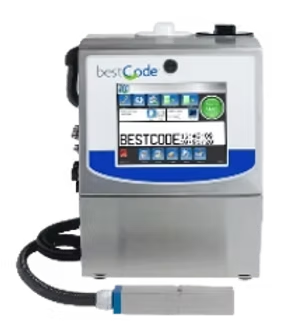
CIJ Printer from Aga Prima Is the Main Choice for High-Speed Expiry Date Printing
CIJ Printer from Aga Prima is the main choice for high-speed expiry date printing on surfaces such as plastic, glass, paper, and metal. This technology uses a high-pressure ink flow that is sprayed in small dots to form text.
How It Works
- Ink flows continuously through the nozzle
- The ink jet is deflected by an electric field to be directed onto the surface
- Unused ink is returned and reused
Advantages
- High speed, ideal for mass production
- Can print on uneven surfaces
- Suitable for various types of primary packaging
Disadvantages
- Ink maintenance and circulation system are relatively complex
- Requires temperature and viscosity settings
2. Thermal Inkjet Printer (TIJ)
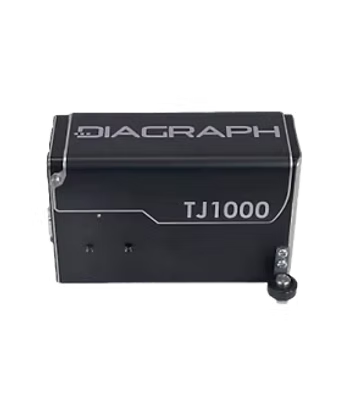
TIJ Printer from Aga Prima Uses Cartridge Technology
TIJ Printer from Aga Prima uses cartridge technology such as HP45A and produces high-resolution prints on secondary packaging and flat surfaces.
How It Works
- Ink is heated until it forms bubbles
- Pressure from the bubbles pushes ink out of the nozzle
- Uses disposable cartridges that are easy to replace
Advantages
- High print resolution, very clear & neat
- Maintenance-free – simply replace the cartridge
- Compact size, easy to integrate into small production lines
Disadvantages
- Not suitable for humid or dusty environments
- Ink consumption is relatively higher per print
3. Thermal Transfer Overprinter (TTO)
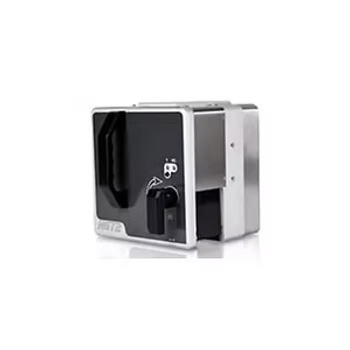
TTO Printer from Aga Prima Is Very Effective for Flexible Packaging
TTO Printer from Aga Prima is very effective for printing expiry dates on flexible packaging, such as plastic film, sachets, and aluminum foil, often used in the food and pharmaceutical industries.
How It Works
- The ink ribbon is heated by the printhead
- Ink is transferred to the packaging surface through pressure & heat
- Suitable for flexible materials such as OPP, BOPP, or PVC
Advantages
- Long-lasting print results & not easily smudged
- High precision in small areas
- Saves ink ribbon because of intermittent printing technology
Disadvantages
- Only works optimally on flexible materials
- Requires precise temperature & pressure settings
4. Industrial Laser Printer
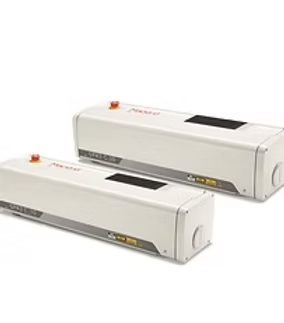
Laser Printer Uses Laser-Based Printing
Laser Printer uses laser-based printing to mark the surface with a laser beam, without using ink. Suitable for permanent, long-lasting, and environmentally friendly printing.
How It Works
- The laser heats the surface to change the color of the material
- The print becomes part of the packaging itself
- Suitable for metal, hard plastic, and carton
Advantages
- No ink = no consumable costs
- High speed, permanent results
- Free from routine maintenance
Disadvantages
- Expensive initial price
- Not suitable for all materials and requires initial testing
Tips for Choosing an Expiry Date Printing Machine
Choosing a printing machine cannot be based only on price. You must consider:
1. Packaging Type
- Plastic, glass, metal ➜ CIJ or Laser
- Carton, flat labels ➜ TIJ
- Sachets, flexible packaging ➜ TTO
2. Production Volume
- High volume ➜ CIJ or Laser
- Small to medium production ➜ TIJ or TTO
3. Production Environment
- Wet/dusty ➜ CIJ with special housing or Laser
- Clean/dry ➜ All machines are suitable
4. Budget and ROI
- Low initial cost, high ink cost ➜ TIJ
- High initial cost, long-term savings ➜ Laser
- Balanced solution ➜ TTO or CIJ depending on the application
5. Integration with Other Machines
Make sure the machine can be connected with conveyor, product sensor, or PLC.
The Right Expiry Date Printing Solution Starts from the Right Partner
Ensuring your products are printed with clear, accurate, and long-lasting expiry dates is not only about regulatory compliance—it is also about building consumer trust and maintaining your brand reputation.
With so many technology choices such as Continuous Inkjet (CIJ), Thermal Inkjet (TIJ), Thermal Transfer Overprinter (TTO), and Industrial Laser Printer, you need a partner who truly understands industry needs and is able to provide solutions that are not only right, but also sustainable.
PT Aga Prima Engineering has been trusted by various leading companies in Indonesia in providing reliable, cost-effective industrial printing systems, and ready to support your productivity.
Do not hesitate to contact the PT Aga Prima Engineering team and consult your specific business needs now. Visit their official website at: agaprima.com