

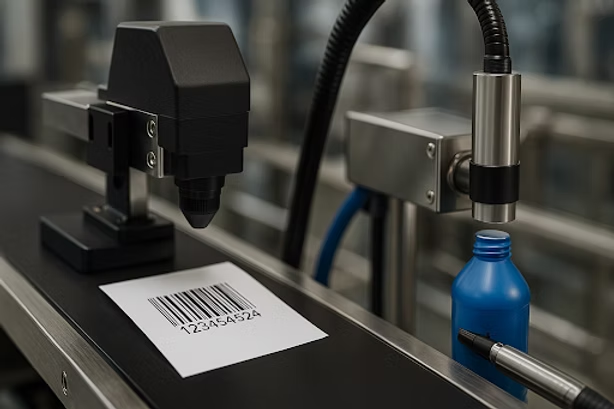
Thermal Inkjet vs Continuous Inkjet: Differences, Advantages, and How to Choose the Right Printer
In the modern manufacturing world, the need to print production codes, expiry dates, and barcodes has become an industry standard. Without a good printing system, products can lose identity, become difficult to trace, and even fail to meet market regulations. Two of the most popular technologies for this need are Thermal Inkjet (TIJ) and Continuous Inkjet (CIJ).
Although both are included in the inkjet printer category, they have major differences in terms of how they work, advantages, and operational costs. Understanding these differences is very important so companies can choose the most suitable printer according to their production needs. This article will explain the main differences between TIJ and CIJ while providing practical guidance for choosing the best technology for business.
What Is a Thermal Inkjet Printer?
Thermal Inkjet Printer (TIJ) works with the drop-on-demand method. The process uses a small heating element that creates vapor bubbles to push ink out of the nozzle in the form of precise droplets. This simple mechanism allows high-quality printing without a complex ink system.
TIJ is often chosen because it is easy to use, has a relatively low initial cost, and requires minimal maintenance. Users simply replace the ink cartridge when it runs out without complicated adjustments. This makes TIJ popular among small and medium businesses that want a practical yet reliable solution.
Read more completely: What Is a Thermal Inkjet Printer
What Is a Continuous Inkjet Printer?
Continuous Inkjet Printer (CIJ) uses a high-pressure ink flow that continuously flows through the nozzle. This ink flow is separated into small droplets using piezoelectric vibration, then directed to the material surface with an electric field. Unused ink droplets will be circulated back to the tank so the system continues to run nonstop.
The advantage of CIJ lies in its very high speed and print media flexibility. This technology allows printing on various surfaces, including plastic, glass, metal, and even curved surfaces. Because of its strong and continuous nature, CIJ is widely used in large industries with high production capacity.
More details: Continuous Inkjet Printer
Advantages of Thermal Inkjet Printer
TIJ is known to excel in producing high-resolution prints, up to 600 dpi. Barcodes, QR codes, and small text can be printed clearly and easily read by scanners. For industries that emphasize detail accuracy, this advantage is very valuable.
In addition, the initial cost of TIJ is relatively low because it does not require a complex ink system such as a pump or circulator. Users only need to buy the main device and ink cartridges according to their needs. Maintenance is also simple, making production downtime more minimal.
TIJ is also environmentally friendly because it is cleaner, does not require many solvents, and has a lower risk of ink spills. With a compact shape, this printer is easy to install even on production lines with limited space.
Advantages of Continuous Inkjet Printer
CIJ is able to print thousands of characters per second, even when products move very fast on the production conveyor. This makes CIJ superior in sectors with large output such as beverages, packaged food, or pharmaceuticals. This speed is difficult to match by other technologies.
Besides being fast, CIJ is also flexible because it can print on almost all types of surfaces. Whether smooth, rough, dark-colored, or curved surfaces, all can be printed well. This capability makes it the main choice for industries with high product variation.
CIJ also uses fast-drying ink that ensures the print does not smudge even on slippery surfaces. Because it is designed for 24-hour operation, this printer is reliable in supporting large production that must not stop.
Thermal Inkjet vs Continuous Inkjet Comparison
| Aspect | Thermal Inkjet (TIJ) | Continuous Inkjet (CIJ) |
|---|---|---|
| Working Principle | Drop-on-demand with heater | Pressurized & circulated ink flow |
| Resolution | Very high (up to 600 dpi) | Medium (70–120 dpi) |
| Speed | Up to ±1.5 m/s | >9 m/s, very high |
| Print Media | Carton, paper, smooth surfaces | Almost all surfaces: plastic, glass, metal, curved |
| Initial Cost | Low | High |
| Maintenance | Minimal, simply replace cartridge | Routine, requires technician & cleaning |
| Ideal Application | Small barcodes, pharmaceutical labels, light packaging | Mass production FMCG, beverages, pharmaceuticals, automotive |
Applications of Thermal Inkjet in Industry
TIJ is widely used in the pharmaceutical industry to print lot numbers and expiry dates on blister packs and small bottles. With high resolution, print results remain clear even on small-sized media. This is very important to meet drug safety regulations.
The medium-scale food and beverage industry also uses TIJ to print production codes on carton labels or secondary packaging. More economical costs make TIJ the right choice for manufacturers who want to remain competitive.
In addition, the cosmetics and health product sectors use TIJ to add authenticity labels, QR codes, or small logos. TIJ is also popular among SMEs because it is easy to install and does not require special technicians.
Applications of Continuous Inkjet in Industry
CIJ is widely used in the beverage industry, especially to print production codes directly on plastic bottles, cans, or glass. With high speed, thousands of products can be printed without obstacles. This technology ensures the distribution flow runs smoothly.
In the automotive industry, CIJ is used to mark metal and plastic components with permanent codes. Because the ink adheres strongly, identification remains readable even when components are exposed to heat or vibration. This is important for product quality and traceability.
Electronics manufacturers also use CIJ to print serial codes on PCBs, cables, or other small components. CIJ supports high-contrast ink that adheres to complex surfaces. Meanwhile, the FMCG industry chooses CIJ to support mass production with very large capacity.
Long-Term Cost Analysis
TIJ is more economical in terms of initial investment and maintenance costs. However, the ink cost per print can be slightly higher because cartridges must be replaced regularly. Even so, for low to medium volume production, TIJ remains more economical and practical.
On the other hand, CIJ does require a high initial cost and periodic maintenance. The ink and solvent system must also be properly maintained so the printer remains stable. However, when used in large-scale production, the cost per print becomes cheaper and more efficient in the long term.
Therefore, choosing between TIJ and CIJ must consider the total cost of ownership (TCO). Companies with small production volumes will benefit more from TIJ, while CIJ is ideal for large companies with output of thousands of products per hour.
Tips for Choosing the Right Printer
First, determine the production scale. If it is only hundreds to thousands of products per day, TIJ is an economical choice. However, if production reaches tens of thousands of units per hour, CIJ is more appropriate.
Second, pay attention to the type of print media. For smooth surfaces such as carton and labels, TIJ is very effective. On the other hand, if the media varies from plastic to metal, CIJ is more flexible.
Third, adjust it to the company budget. TIJ requires lower initial capital, while CIJ is a long-term investment. Finally, make sure there is adequate technical support. Without internal technicians, TIJ is easier to use, while CIJ requires routine maintenance.
Conclusion
Both Thermal Inkjet Printer and Continuous Inkjet Printer have important roles in the industrial world. TIJ excels in high resolution, low cost, and flexibility for small to medium production. Meanwhile, CIJ is more reliable for large production that demands speed, durability, and media flexibility.
Choosing the right printer means adjusting production needs to the advantages of each technology. With careful calculation, companies can optimize costs while maintaining print quality.