

Industrial Inkjet Printer vs Regular Printer: Why Industry Needs a Specialized Printing Solution
In the modern industrial world, printing needs are no longer limited to documents or simple images. Companies now demand printing systems that can work quickly, flexibly, and accurately to support mass production. Therefore, industrial inkjet printer is present as a more advanced solution compared to regular printers.
Regular printers are indeed sufficient for household or small office needs, but they are limited in terms of durability and print media. On the other hand, industrial printers are designed to operate continuously in heavy production environments. This difference makes industrial inkjet printers increasingly relevant for various manufacturing sectors.
What Is an Industrial Inkjet Printer?
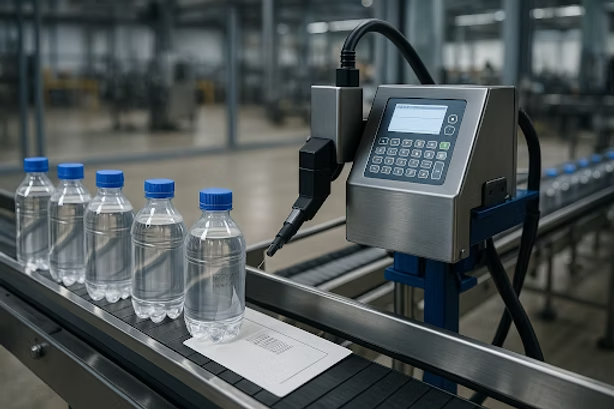
Industrial inkjet printer is a special device used to print production codes, expiry dates, logos, and barcodes directly on products. This technology is different from household printers because it can work on non-paper surfaces.
Examples include plastic, glass, metal, carton, and even textured materials.
Another advantage of industrial inkjet printer is its durable design and support for high-speed printing. This machine can be used in fast-moving production lines without losing print quality. In other words, industrial inkjet printer is more than just a printing tool, but an important part of the modern production chain.
Production Speed
One of the main advantages of industrial inkjet printer is its ability to print in large quantities at high speed. In one hour, this machine can print thousands of products without reducing print quality. This greatly helps the food, beverage, and pharmaceutical industries that require speed to meet market demand.
Regular printers are not designed for this kind of workload. When forced to work in large volumes, regular printers wear out quickly, often experience problems, and reduce productivity. This is why industrial inkjet printers are superior for companies that operate with strict targets.
Print Media Flexibility
Industrial inkjet printer is able to print on almost all surfaces. From plastic beverage bottles, medicine packaging made of aluminum foil, to cables and electronic components, all can be given codes or labels. This capability provides high flexibility for companies with a wide variety of products.
Meanwhile, regular printers are only limited to paper media or special labels. If used on non-paper surfaces, print quality is often not optimal or even fails to stick. This difference is what makes industrial printers more relevant for real needs in the field.
Print Quality and Durability
Industrial inkjet printer print results are designed to dry quickly and last long. The ink used has a special formulation so it does not easily smudge even when exposed to humidity, friction, or heat. This is important to ensure information such as production codes remains readable throughout the product life cycle.
Unlike regular printers, print results are often only suitable for documents stored indoors. If exposed to water or friction, the ink fades easily. Therefore, regular printers cannot be relied on for industrial applications that demand long-term durability.
Operational Durability
Industrial inkjet printers are designed to operate 24 hours in heavy conditions. These machines are equipped with ink circulation systems and automatic maintenance features that ensure stable performance. Even on production lines with thousands of units per hour, this machine continues to work optimally.
On the other hand, regular printers will quickly break down if used continuously. Their components are not designed for high work volumes, so they often experience overheating or wear. This durability difference is what makes industrial inkjet printers far more reliable.
Long-Term Cost Efficiency
Although the initial price of industrial inkjet printer is higher, its operational costs tend to be more economical in the long term. The risk of printing errors is lower, so companies do not need to discard products because labels are unreadable. This investment actually saves overall production costs.
Regular printers may look cheap at first, but they often cause additional costs. More frequent maintenance is needed, ink runs out quickly, and work capacity is limited. If calculated in total, the cost of using regular printers can be much greater compared to industrial printers.
Comparison of Industrial Inkjet Printer vs Regular Printer
When viewed from the technical side, the difference is very clear. Industrial printers have printing speeds of up to thousands of products per hour, while regular printers are limited to several sheets per minute. In terms of media, industrial printers can print on plastic, glass, and metal, while regular printers only print on paper.
In terms of quality, industrial printers produce long-lasting prints, while regular printers are only suitable for internal needs. Long-term costs are also different: industrial printers are more efficient for mass production, while regular printers are only practical for light needs. In other words, industrial printers are an investment, not just a tool.
Applications of Industrial Inkjet Printer
In the food and beverage industry, this printer is used to print expiry dates on bottles, cans, or carton packaging. Consumers can immediately see this important information without worrying about the ink smudging. This technology supports both consumer safety and convenience.
In the pharmaceutical sector, industrial inkjet printer functions to print batch codes, serial numbers, and QR codes on blister packs and medicine bottles. Print clarity is an important factor because it is related to patient safety. Even a small error can have fatal consequences in this industry.
The automotive industry also relies on this technology to mark metal and plastic components. Identification codes on spare parts make the tracking and quality control process easier. Meanwhile, the electronics sector uses industrial inkjet printer to mark cables, PCBs, and other small devices.
Tips for Choosing a Printer for Business
Before choosing a printer, companies need to assess the production scale. If only document printing or small label printing is needed, a regular printer is sufficient. However, if the production scale is large and direct printing on products is required, an industrial printer is the main choice.
In addition, companies also need to consider the type of media to be printed. For plastic, metal, or glass, regular printers clearly cannot be relied on. In this case, BestCode Inkjet Printer is one of the best solutions for modern industrial businesses.
Conclusion
Industrial inkjet printer has many advantages compared to regular printers, ranging from speed, flexibility, durability, to long-term cost efficiency. This technology ensures every product has a clear, long-lasting identity and complies with international standards.
For companies that want to increase productivity and maintain quality, industrial printers are the right investment. By choosing the right device, businesses can be more competitive and ready to face modern market challenges.