

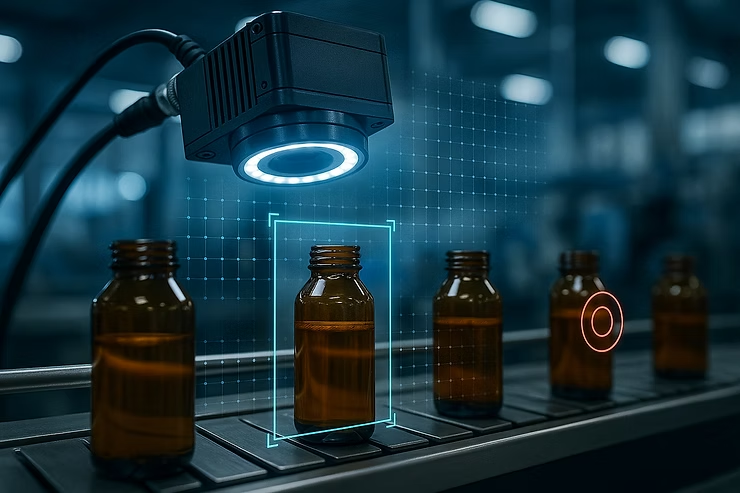
Vision Camera System: Smart Solution for Product Defect Detection in Automatic Industry
In the modern industrial era, maintaining product quality is no longer just an option, but a necessity. Consumers demand high standards and consistency, while companies strive to maintain efficiency without increasing production costs. In this situation, vision camera system technology is present as an effective automation solution to detect product defects accurately and quickly.
If previously visual inspection was carried out manually by human operators, now intelligent camera systems are able to take over the process with a much higher level of precision. This technology not only increases accuracy, but also provides real-time data that is very valuable for continuous improvement in the manufacturing process.
What Is a Vision Camera System?
Vision camera system is an automatic inspection technology based on digital images used to check product quality on the production line. This system consists of several main components, such as high-resolution industrial cameras, special lighting systems, controller units, and image analysis software equipped with artificial intelligence (AI) algorithms.
The way it works is simple but effective. The camera captures images of every product passing through the production line, then the software analyzes the captured results to detect defects or nonconformities. If an anomaly is found — for example, incorrect color, different size, or damaged parts — the system will give a warning signal or automatically reject the product.
Why Is Vision Camera System Important for Automatic Industry?
In high-speed production processes, humans have limitations in maintaining consistency. Factors such as fatigue, subjectivity, and work speed often reduce the accuracy of manual inspection. This is why vision camera system becomes an important need in various industrial sectors.
With the help of visual algorithms, this system is able to detect defects in milliseconds without losing focus. In addition, this system can be integrated directly with conveyor, coding printer, or marking machine, so the entire inspection, labeling, and packaging process can run automatically in one workflow.
Advantages of Vision Camera System in Product Defect Detection
1. Extraordinary Inspection Speed
One of the biggest advantages of vision camera system is its ability to process hundreds to thousands of products per minute. With this speed, the system is suitable for use in industries that have high mass production levels such as food, pharmaceuticals, and automotive. There is no pause between products, and every inspection is carried out consistently without reducing result quality.
2. High Accuracy and Consistency Without Fatigue
This system is able to detect microscopic defects that cannot be seen by the human eye, even in low-light conditions or complex production environments. Its accuracy level can reach more than 99%, ensuring that only the best products pass to the next stage. This consistency maintains brand reputation and reduces the risk of product returns from customers.
3. Real-Time Data for Production Analysis
In addition to detecting defects, vision camera system also records and sends visual data directly to the server. This data can be used to analyze error patterns, determine weak points in the production line, and help the engineering team take preventive action. Thus, the system does not only function as a detection tool, but also as a source of operational insight.
4. Production Cost Efficiency
Although the initial investment in vision inspection system is relatively large, its long-term benefits are much more significant. By reducing the reject rate, companies can save raw material costs and reduce waste. Productivity increases because there is no need for manual re-inspection, while production results become more uniform and meet quality standards.
5. Integration with Industrial Automation Systems
Another advantage of vision camera system is its ability to integrate with other industrial equipment. This system can be synchronized with coding printers, pick and place robots, or automatic packaging systems. This creates a truly efficient, fast, and intelligent production chain.
Application of Vision Camera System in Various Industries
This technology is now widely used in various sectors:
- Food and beverage industry: to check labels, packaging seals, or product fill quantity.
- Pharmaceutical industry: to ensure authenticity of batch codes and expiry dates.
- Automotive and electronics industry: to check dimensions and precision of small components.
- Cosmetics and FMCG industry: to avoid aesthetic defects on packaging and bottles.
For example, the vision inspection system used by large beverage manufacturers is able to scan every bottle at high speed. The camera checks labels, caps, and liquid contents automatically, ensuring that no defective products pass to the market. The result is increased efficiency and higher customer satisfaction.
Challenges and How to Optimize Them
Although it offers many advantages, the implementation of vision camera system also has its own challenges. One of them is lighting conditions in the production area that are not always ideal. Reflections from product surfaces or dust on the camera lens can affect detection accuracy.
To overcome this, periodic system calibration and proper lighting adjustment need to be carried out. The use of high-resolution cameras and modern AI-based algorithms also helps the system adapt to various production conditions.
In addition, technical support and operator training become important factors. With a good understanding of analysis software and inspection parameters, users can optimize system performance without requiring excessive intervention from external parties.
Conclusion
Vision camera system has become an important part of modern industry that prioritizes efficiency, accuracy, and automation. Its ability to detect defects quickly and provide real-time data makes it a smart investment for companies that want to maintain product quality at the highest level.
With the implementation of this system, companies can minimize errors, increase customer satisfaction, and strengthen competitiveness in the global market. This technology is no longer just a supporting tool, but a main foundation in realizing the concept of smart manufacturing.
If you want to implement a professional vision inspection system with complete technical support and the best industrial device integration, contact Agaprima.com immediately. We provide smart camera and vision inspection system solutions designed to improve the productivity and efficiency of your production line.knis lengkap dan integrasi perangkat industri terbaik, segera hubungi Agaprima.com. Kami menyediakan solusi smart camera dan vision inspection system yang dirancang untuk meningkatkan produktivitas dan efisiensi lini produksi Anda.