

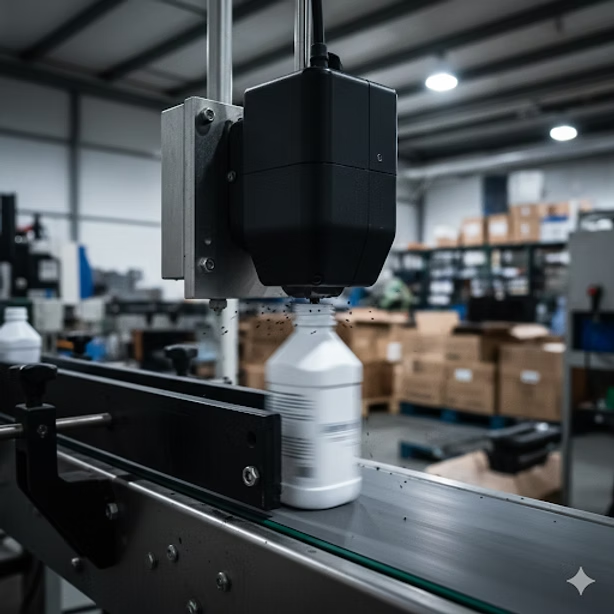
How Expired Date Coding Machines Work to Improve Product Traceability
In the world of manufacturing and packaging, small details often determine major success. One of those details is the row of numbers and characters printed on product packaging: expired date codes and batch numbers. For consumers, this is safety information. However, for manufacturers, this row of codes is the backbone of the traceability system.
Without a reliable coding machine, a manufacturing company will have difficulty monitoring the movement of its products in the market.
This article will deeply explain how expired date coding machines work and why this technology becomes the main key in maintaining product integrity and transparency from the factory to the hands of consumers through Aga Prima.
What Is Traceability and Why Is It So Important?
Traceability is the ability to track the history, application, or location of an entity through recorded identification. In the food, beverage, pharmaceutical, and cosmetic industries, traceability allows manufacturers to:
- Perform Recalls with Precision: If a production defect is found in one batch, manufacturers only need to withdraw products with certain codes, not all stock in the market.
- Regulatory Compliance: BPOM and international institutions require the inclusion of expiry dates for consumer protection.
- Inventory Management: Ensuring the FIFO (First In, First Out) principle runs perfectly in distributor warehouses.
Types of Expired Date Coding Machine Technologies
Before understanding how it works, we need to know the most commonly used technologies in today’s industry. Each technology has a different mechanism for printing expiry codes.
1. Continuous Inkjet (CIJ)
This technology is the most popular for high-speed production lines. CIJ machines spray ink droplets continuously onto the packaging surface without touching the product, or non-contact.
2. Thermal Transfer Overprinting (TTO)
TTO works by transferring ink from a ribbon to flexible packaging using heat. This technology is ideal for printing high-resolution codes on snack food plastic packaging or labels.
3. Thermal Inkjet (TIJ)
TIJ machines use a cartridge system similar to home printers but with industrial speed. Its advantages are cleanliness and ease of maintenance, making it very suitable for the pharmaceutical industry.
How Expired Date Coding Machines Work: Step by Step
How can a machine print thousands of codes in minutes with consistent accuracy? Here is the process:
A. Data Setting on the Controller
The process starts at the machine control unit. The operator enters data in the form of production date, product shelf life, and batch code. Modern machines provided by Aga Prima usually have automation features where the expiry date will be calculated automatically based on the production date running in real time.
B. Product Detection Through Sensors
Coding machines do not work randomly. On the production line or conveyor, there is a photoelectric sensor that functions to detect the presence of products. When the product passes the sensor, a signal is sent to the printhead to start the printing process exactly at the desired position.
C. Inkjet Process in CIJ Technology
In CIJ technology, ink is flowed from the tank to the printhead. Inside the printhead, ink is broken into thousands of small droplets by a piezoelectric crystal. These droplets are then given an electric charge. Deflection plates will deflect the charged ink droplets toward the product to form characters, such as numbers or letters, while uncharged ink is pulled back into the circulation system to be reused.
D. Instant Drying
The ink used in expired date coding machines is specially designed to dry in less than one second. This is crucial so the code does not smudge or smear when products touch each other or enter the next packaging stage.
The Role of Coding in Improving Product Traceability
Coding machines are not just tools for printing numbers; they are data input tools into a global tracking system. Here is how they improve traceability:
1. Digitalization of Product Identity
With modern coding machines, manufacturers can print QR codes or barcodes that are unique for each batch. When this code is scanned, information about the production date, raw materials used, and the operator on duty can appear immediately.
2. Product Counterfeiting Prevention
Expiry codes printed with high technology are difficult to manipulate without damaging the packaging. This protects the brand from counterfeiting attempts that are financially and reputationally harmful.
3. Supply Chain Transparency
With clear coding, distributors and retailers can easily track the remaining shelf life of products. If a claim occurs from consumers in a certain area, the company can trace back which production line made the product and find out whether there was an error in the machine or raw materials.
Comparison Table of Coding Technologies for Traceability
| Feature | Continuous Inkjet (CIJ) | Thermal Transfer (TTO) | Thermal Inkjet (TIJ) |
|---|---|---|---|
| Speed | Very High | Medium – High | Medium |
| Print Media | All Surfaces: Bottles, Cans, Plastic | Flexible Packaging: Plastic, Foil | Carton, Paper, Certain Plastic |
| Resolution | Standard: Dot Matrix | Very High: 300 DPI | High: 600 DPI |
| Operational Cost | Low: Bulk Ink | Medium: Ribbon | Medium: Cartridge |
Challenges in the Expired Date Coding Process
Although it looks automatic, the coding process still has challenges that must be anticipated by the production team:
- Extreme Environment: Production rooms that are too humid, dusty, or low-temperature, such as in the frozen food industry, can affect ink adhesion.
- Conveyor Speed: If conveyor speed is not synchronized with the printhead, print results can appear stretched or broken.
- Machine Maintenance: Without routine maintenance, nozzles on inkjet machines can become clogged by dried ink.
Therefore, choosing a machine provider partner such as Aga Prima that provides technical support and quality machines is a very important investment.
Conclusion
Expired date coding machines are investments that may look small compared to main raw material processing machines, but their role in safety and consumer trust is very vital. With a precise working mechanism, this machine ensures that every product leaving the factory has a clear digital “identity card.”
In modern industrial competition, traceability is no longer an option, but a minimum standard that must be met. Companies that ignore coding quality risk facing major losses due to inefficient product recalls or failure to meet government regulations.
Do you want to improve product safety and tracking standards in your factory?
Find various best coding, marking, and labeling machine solutions only at Aga Prima. We provide the latest technology designed to work optimally in various industrial conditions. Do not let your product quality be compromised only because of problems with expiry codes.