

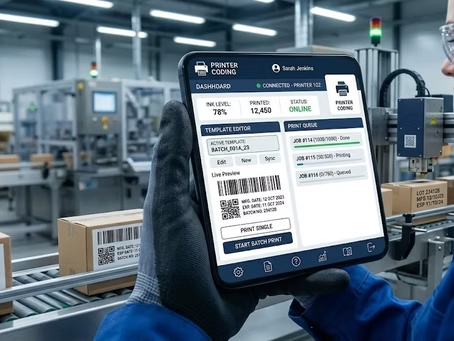
Applications of Coding Printers in Various Industries
In the world of modern production, information on packaging is not just a complement. Production codes, expiry dates, batch numbers, barcodes, QR codes, and product tracking information have an important role in maintaining quality, safety, and consumer trust. To print this information quickly and consistently, many companies use industrial coding printers.
A coding printer is a machine used to print certain codes or information on products or packaging. This machine can be applied to various materials, such as plastic, carton, glass, cans, aluminum foil, bottles, sachets, labels, and flexible packaging. With the right technology, the coding process can run more accurately, neatly, and efficiently on the production line.
Why Are Coding Printers Important for Industry?
Every product circulating in the market usually requires a clear identity. Information such as production date, expiry date, batch number, and lot code helps both manufacturers and consumers know the origin and validity period of the product.
On an industrial scale, coding printers help companies to:
- Print product information automatically
- Maintain consistent print results
- Speed up the production process
- Reduce manual marking errors
- Support traceability systems
- Meet regulatory and industry standard needs
- Simplify the product recall process if quality problems occur
Without a good coding system, companies can face major risks, ranging from information errors on packaging, products being difficult to trace, to potential losses due to customer complaints or non-compliance with distribution standards.
Applications of Coding Printers in the Food and Beverage Industry
The food and beverage industry is one of the sectors that uses coding printers the most. Almost all food and beverage products require information such as expiry date, production date, batch number, and factory code.
Coding printers are used on various types of packaging, such as:
- Plastic bottles
- Glass bottles
- Cans
- Sachets
- Pouches
- Cartons
- Boxes
- Plastic cups
- Frozen food packaging
- Plastic wrap
In the food industry, print speed and clarity are important factors. Products usually move quickly on conveyors, so coding machines must be able to print stably without slowing down the production process. In addition, print results must be resistant to certain conditions, such as cold temperatures, humidity, oil, or friction during distribution.
Examples of applications include printing expired dates on beverage bottles, production codes on snack packaging, batch numbers on dairy products, or QR codes on ready-to-eat food packaging.
Applications of Coding Printers in the Pharmaceutical Industry
The pharmaceutical industry requires a highly accurate coding system because it is directly related to patient safety and regulatory compliance. Pharmaceutical products such as tablets, capsules, syrups, ampoules, blister packs, and carton packaging must have clear and traceable information.
Coding printers in the pharmaceutical industry are usually used to print:
- Batch numbers
- Production dates
- Expiry dates
- Registration numbers
- Barcodes
- QR codes
- Product serialization information
In addition to printing codes, the pharmaceutical industry also often requires additional inspection systems such as vision camera systems. This system can help check whether the code has been printed correctly, is clearly readable, and matches production data. That way, the risk of misprinted products or products without codes can be minimized.
In the pharmaceutical industry, small errors in packaging information can have major impacts. Therefore, the coding printer used must have high precision, stability, and be easy to integrate with the production system.
Applications of Coding Printers in the Cosmetics and Personal Care Industry
Cosmetic and personal care products also require neat and long-lasting coding. Cosmetic packaging often uses various materials, such as plastic bottles, tubes, jars, glossy labels, pouches, and premium cartons. Therefore, the selection of coding printer type must be adjusted to the packaging surface.
Coding applications in the cosmetics industry include:
- Expired dates on skincare packaging
- Batch numbers on make up products
- Production codes on shampoo bottles
- Barcodes on product boxes
- QR codes for product authentication
The appearance of print results is also an important concern. Because cosmetics are closely related to branding, coding results must look clean, not damage the packaging design, and remain easy to read.
Applications of Coding Printers in the FMCG Industry
The FMCG or fast-moving consumer goods industry requires a fast and efficient coding system. Products in this category are produced in large volumes and move quickly in the market. Examples include household products, beverages, snacks, detergents, soap, tissue, and other daily needs.
In the FMCG industry, coding printers are used to maintain production speed while ensuring every product has a clear identity. The coding machine used must be able to work for long durations and follow conveyor speed.
The main needs of the FMCG industry include:
- High print speed
- Consistent print results
- Easy maintenance
- Low downtime
- Efficient ink or ribbon consumption
- Integration with automatic production lines
If the coding system often has problems, production can be delayed and cause operational losses. Therefore, choosing a reliable coding machine becomes very important.
Applications of Coding Printers in the Electronics and Automotive Industry
In addition to food and pharmaceuticals, coding printers are also used in the electronics and automotive industries. In this sector, product codes function for component identification, production tracking, warranty, and quality control.
Coding printers can be used to print on:
- Plastic components
- Cables
- PCB
- Product labels
- Carton packaging
- Certain metal components
- Automotive spare parts
The codes printed can include serial numbers, barcodes, QR codes, part numbers, or production codes. This information helps companies track components from the production process to distribution.
Common Types of Coding Printers Used
Each industry has different needs, so the type of coding printer used must also be adjusted. Some commonly used technologies include:
- Continuous Inkjet Printer / CIJ: Suitable for fast production lines and various types of packaging surfaces.
- Thermal Inkjet Printer / TIJ: Suitable for sharp print results on carton packaging, labels, and certain materials.
- Thermal Transfer Overprinter / TTO: Commonly used on flexible packaging such as sachets, pouches, and plastic film.
- Laser Marking Printer: Suitable for permanent print results without ink on certain materials.
- Print and Apply Labeling System: Used to print and apply labels automatically on products or cartons.
- Vision Camera System: Functions to check print results, barcodes, QR codes, or labels to meet quality standards.
Coding Printer Solutions from Aga Prima
For industrial marking and coding needs, PT Aga Prima Engineering is present as a partner that provides coding printer solutions, industrial marking, vision systems, laser printers, and labeling systems. Through the website https://www.agaprima.com/, Aga Prima offers various solutions to help companies improve production line efficiency and maintain coding result quality.
Aga Prima also supports industrial needs with machine choices, spare parts, technical services, and purchase or rental options according to operational needs. With support from an experienced team, companies can choose the coding technology most suitable for product type, packaging material, production speed, and required quality standards.
Coding printers have an important role in various industries, from food, beverage, pharmaceuticals, cosmetics, FMCG, electronics, to automotive. With the right coding system, companies can print product information accurately, support traceability, meet regulatory standards, and improve production efficiency.